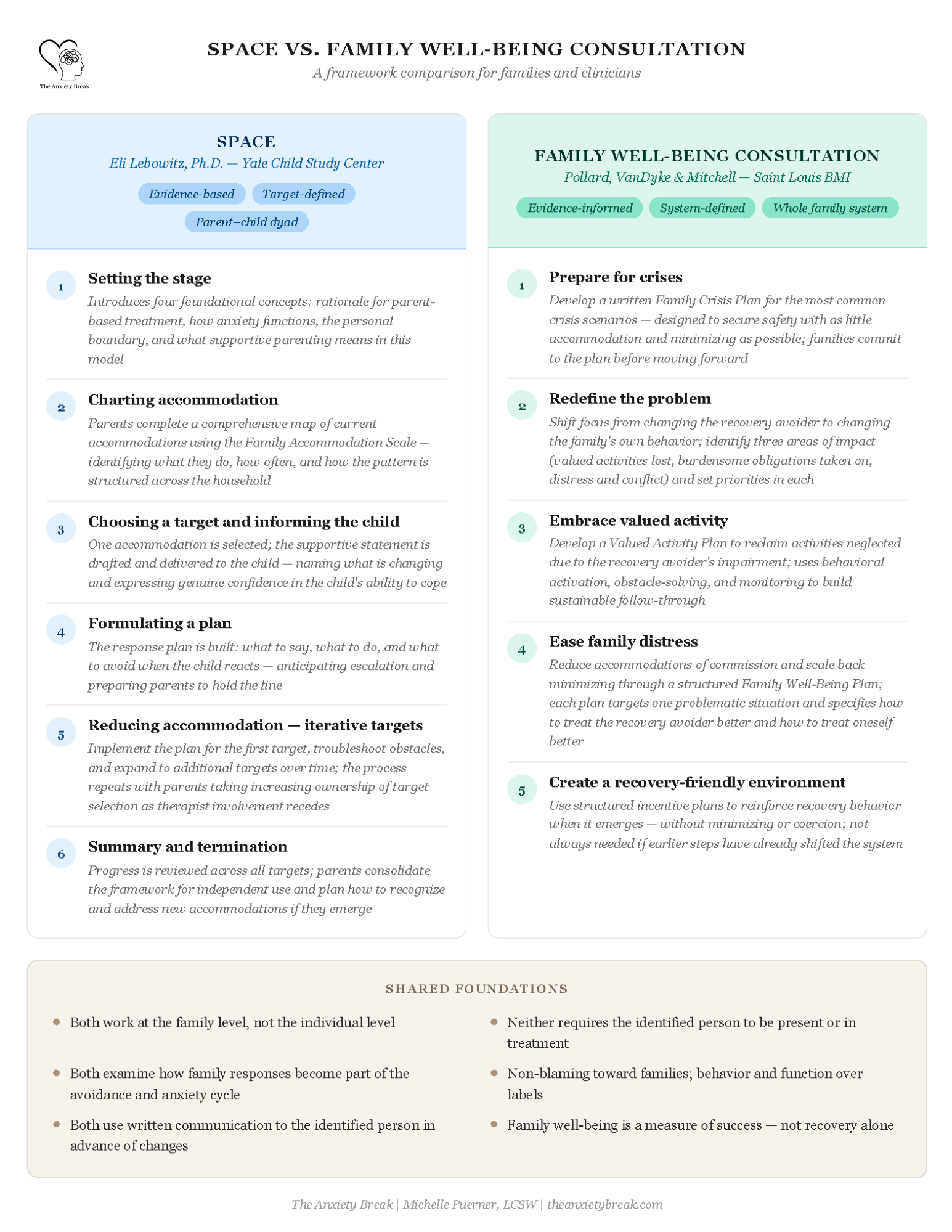

SPACE VS. FAMILY WELL-BEING CONSULTATION: WHAT'S THE DIFFERENCE?
Families searching for support around OCD, anxiety, avoidance or accommodation patterns may come across both the SPACE model and Family Well-Being Consultation approaches.
Some families are referred directly to SPACE by a therapist or provider. Others may encounter Family Well-Being Consultation concepts after reading When a Loved One Won't Seek Mental Health Treatment (Pollard et al., 2024) or recognizing that the entire household has gradually become organized around managing distress, avoidance or emotional escalation.
Both approaches recognize that anxiety does not only affect the person who is struggling. Over time, OCD and anxiety disorders can reshape relationships, routines, communication patterns and family functioning itself.
The two models share more common ground than is often recognized, but they are not the same thing, and the distinction is worth understanding when choosing the best model for your family. If you prefer to start with the overview, there is a side-by-side comparison infographic at the bottom of this page.
WHAT IS SPACE?
SPACE stands for Supportive Parenting for Anxious Childhood Emotions. It is a structured, evidence-based treatment model developed by Eli Lebowitz at Yale's Child Study Center, with one of the strongest research bases currently available for childhood anxiety, and growing application to OCD. Research on OCD and family accommodation increasingly highlights how anxiety-driven patterns can become reinforced not only within the individual, but throughout the environment around them.
The central premise, even if the application is not straightforward, is that anxiety in children is often maintained, at least in part, by the accommodations families make around the anxiety. Parents answer reassurance questions repeatedly to calm fears. They steer children away from situations that trigger distress. They rearrange routines, adjust plans and step in to eliminate uncertainty before it can build.
All of this comes from care. Many families do not initially recognize these patterns as accommodation. They experience them as helping, protecting, preventing escalation or simply getting through the day.
But over time, family accommodation teaches the brain that anxiety is something to be rescued from rather than tolerated. Avoidance gets reinforced, the pattern deepens and the household gradually begins orienting itself around managing distress.
SPACE works directly with parents by identifying accommodation patterns that are maintaining anxiety and building structured plans to reduce them. Parents identify one accommodation they are working to reduce, build a plan around that change and craft a clear, supportive message to communicate the shift to the child. The supportive statement, the way a parent tells the child something is changing and expresses genuine confidence in their ability to cope, is a central piece of the work. Everything else, the response to escalation, the adjustment of routines, the attention to what happens next, is in service of reducing that one accommodation effectively.
The child does not have to participate. The target of treatment is the parent's behavior, not the child's.
While SPACE can be especially valuable in cases of treatment resistance, that is not its only application. Many families use SPACE alongside a child’s individual ERP therapy to help parents respond differently to anxiety and OCD at home. In these cases, the work is not replacing the child’s treatment but strengthening the environment around it so the changes the child is making in therapy can be supported and reinforced more consistently outside the session.
SPACE can also be highly effective in situations involving treatment resistance, where a child or adolescent is unwilling or unable to engage in individual therapy. The parents become the vehicle for change, and the research supports that approach even when the child never enters the room.
Over time, SPACE has also been adapted and applied to other situations involving accommodation, avoidance, dependency and anxiety-driven family patterns, including ARFID, school refusal and some "failure to launch" dynamics. While the strongest research base remains in childhood anxiety, with growing application to OCD, the broader framework has influenced how many clinicians conceptualize accommodation and family participation across a range of presentations.
WHAT IS FAMILY WELL-BEING CONSULTATION?
Family Well-Being Consultation takes a broader view. It is a structured, evidence-informed and systems-informed consultation model drawing on research across family systems theory, behavioral science and process-based approaches. The model includes defined steps, worksheets and a published framework, but it has not been evaluated through randomized controlled trials in the same way SPACE has.
Rather than targeting a specific diagnosis or a defined behavior pattern, Family Well-Being Consultation looks at how the family system as a whole is organized and functioning. Where is stress concentrated? What communication patterns are sustaining difficulty? What roles have family members taken on, and what are those roles doing for the system? What does the family believe is happening, and how is that belief shaping what they do?
Because it begins with the whole picture rather than a specific target, Family Well-Being Consultation often starts with stabilization before anything else. When a family is in acute stress, when there is high conflict, significant emotional escalation or a sense that the ground is not yet steady, the first task is to identify where the system is overwhelmed and what each person can realistically sustain. That often means developing a shared understanding of the crisis, building response plans for when things spike and helping the family reclaim enough day-to-day functioning to be able to do anything else. That is not a waiting room for the real work but the beginning of it.
In some situations, especially when OCD or anxiety has been present for years, the family system itself may become increasingly organized around preventing distress, avoiding escalation, maintaining stability or managing the disorder day-to-day. In these more chronic or entrenched systems, Family Well-Being Consultation may offer a broader systems-focused framework for helping the family reclaim functioning and flexibility over time.
Family Well-Being Consultation also examines accommodation and participation in anxiety-driven patterns; it covers overlapping territory with SPACE. But it places accommodation alongside two other family behaviors, recovery avoidance and minimizing, and reducing any of these is one component of a broader framework that also includes crisis stabilization, communication change and supporting the family's own functioning and valued activity. The organizing question is not which accommodation to reduce but what this family's functioning looks like and where it is most depleted.
The question FWB is asking is not only what a parent is doing but what the whole system is organized around and why.
Accommodation does not exist in a vacuum. It develops inside a family system with its own patterns, history and organizing beliefs, and understanding that broader context is often what makes change possible.
This matters in practice. Families are not just collections of individuals who happen to share a household. When anxiety or OCD has been present for a long time, avoidance, reassurance and emotional escalation tend to become structurally embedded, shaping how the family communicates, how conflict gets managed and what everyone has come to expect. Seeing that structure clearly is part of what Family Well-Being Consultation is designed to do.
It is not family therapy in the traditional sense but structured inquiry that helps a family see its own patterns clearly enough to begin changing them.
SHARED FOUNDATIONS
Both approaches work at the family level, not the individual level. Both recognize that when one person is struggling with anxiety or OCD, the people around them are already involved, whether anyone intended that or not, and that working with one person in isolation often misses what is sustaining the problem.
Both frameworks orient around function over labels. Neither assigns blame to parents for responding in ways that often developed out of trying to keep the family functioning, stable or emotionally safe. Both are interested in understanding the patterns that sustain difficulty and what it would take for things to shift.
Both examine accommodation and participation in anxiety-driven patterns while combining behavioral specificity with broader systems thinking. The two frameworks are related, not opposed. A SPACE session and a Family Well-Being session addressing accommodation will overlap meaningfully and do not fully substitute for one another.
Both frameworks rest on the premise that the responses people naturally make to anxiety and distress can gradually shape whether those patterns become more entrenched or more flexible over time.
Neither model requires the identified person to be present, in agreement or actively engaged in treatment themselves. Both are designed to help families do meaningful work even when the person they are most worried about will not participate directly, and that is often the reason families seek either approach out in the first place. It is a defining feature of both frameworks, not a feature of one.
KEY DIFFERENCES
The clearest difference is in what each framework is organized around.
SPACE is target-defined. The treatment is built around identifying a specific accommodation and working systematically to reduce it. The supportive statement, the response plan and the attention to escalation are all in service of changing that one behavior effectively. It is the right tool when the question has a clear behavioral target, when the goal is identifying which accommodation is maintaining the pattern and what needs to change around it.
Family Well-Being Consultation is system-defined. The unit of intervention is the family's overall functioning, not a specific behavior. Accommodation is one of several behaviors the framework addresses, and reducing it is one step in a broader arc. The pacing follows where the family is, not where a particular target is. It is the right tool when the question is less about any single target and more about what the family's overall functioning looks like.
That difference also shows up in the breadth of the family-level inquiry. SPACE works primarily with parents around a defined accommodation target; the parent-child dyad is the operative unit. Family Well-Being Consultation opens the lens wider. Co-parenting dynamics, sibling impact, how the household communicates under stress and how each family member understands what is happening in their loved one’s situation are all part of the assessment and often central to the work.
The evidentiary basis is also worth mentioning. SPACE is an evidence-based treatment model with randomized controlled trial support. Family Well-Being Consultation is a structured, evidence-informed consultation model with a published framework and preliminary supporting research, but without the same level of empirical validation currently available for SPACE. That distinction matters for how both models are honestly represented.
WHO EACH MAY HELP MOST
SPACE tends to be a strong fit when anxiety or OCD is the primary concern and family accommodation has become significantly entrenched. While it can be especially helpful in cases of treatment resistance, it is also commonly used alongside individual therapy to help parents reduce accommodation and respond differently to anxiety-driven patterns within the home. Parents who are willing to take an active role in changing the system around the anxiety, often against every instinct, tend to get a great deal out of the work.
Family Well-Being Consultation tends to be useful when the presenting concern is not clearly defined, or when multiple dynamics are happening at once and need to be sorted before more targeted work begins. It is also a practical starting point for families navigating high conflict, acute stress or patterns that have been building for years. When the system is overwhelmed and the family does not yet have enough stability to sustain structured protocol work, starting with Family Well-Being Consultation gives the work somewhere solid to stand.
A meaningful outcome of either approach is sometimes that the identified person becomes more willing or able to enter their own treatment. Not because anyone pushed, but because the family stopped organizing itself around avoidance and the system shifted. Neither model promises this, and both define success in terms of family well-being regardless of what the identified person ultimately chooses to do.
HOW THEY CAN COMPLEMENT ONE ANOTHER
In practice, these two approaches are rarely entirely separate. Families dealing with a child's anxiety are rarely dealing with only that. There is also the stress of trying to parent it well, the disagreements between caregivers about how to respond and the accumulated weight of a household that has reorganized itself around managing distress.
When SPACE is the primary structure, Family Well-Being concepts provide important context. Understanding how aligned caregivers are, what relational stressors are affecting the system, how the family has come to understand the problem and what beliefs are driving their responses can make the difference between SPACE that progresses and SPACE that stalls.
I regularly work with both at once. The accommodation reduction work that SPACE calls for happens inside a broader family context, and that context matters. Holding both at once, attending to stabilization when needed while staying curious about the whole system, tends to produce more durable change than running either approach alone.
Anxiety does not live in isolation; it lives inside relationships, routines, patterns and systems. Understanding those systems, and knowing which tools to bring, is most of the work.